




Blog Overview
I started blogging again in July 2023 after some shifting of my job responsibilities, and my children growing up which gave me a lot more discretionary time. I do this for me, but I hope some others find my posts interesting or useful in some way.The Coming AI-Fueled Recession: Efficiency Meets Unemployment
2/26/2026 by Alan
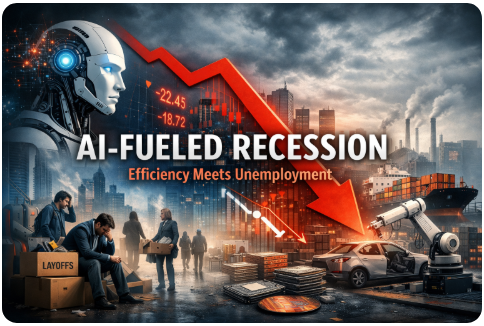
AI may not cause a recession because it fails — but because it succeeds. As companies cut payroll and boost margins with automation, the ripple effects could push markets into bear territory. Is efficiency about to collide with employment?
Post Content, Images & Videos
The Coming AI-Fueled Recession: Efficiency Meets Unemployment
Every major technological revolution has reshaped the economy, but artificial intelligence may be the first one to spark a recession by doing its job too well. The signs are forming: widespread layoffs, margin expansions on reduced payrolls, and investor rotations into “hard good” sectors that still rely on physical output rather than code. A 20% or greater correction across major indexes—by some definitions a full bear market—feels increasingly plausible as AI’s disruptive potential ripples outward.
The Mechanics of an AI-Driven Slowdown
Unlike typical recessions driven by interest-rate shocks or cyclical consumer retrenchment, an AI-fueled downturn could start as a productivity shock. Companies discovering they can accomplish the same output with fewer people are already starting massive layoffs in tech and services—CRM and smaller SaaS firms are early case studies.
Management logic is simple: why pay ten engineers or marketers when generative AI tools can produce similar outputs with three? That microeconomic logic can add up to a macroeconomic problem. Displaced workers cut consumption, contractors lose clients, and small-to-mid sized vendors face falling revenue as enterprise customers “optimize” away spend. That ripple could hit service-heavy indexes—like the NASDAQ and parts of the S&P—pushing them into bear market territory.
Importantly, this is not merely a cyclical cost-cutting exercise. The efficiency is structural. Stimulus or a rate cut helps when demand is suppressed by cyclical factors; it helps less when aggregate demand falls because labor demand has permanently shifted down in certain sectors.
How The Labor Market Actually Shifts
This transition is a once-in-a-generation reallocation of labor. Millions may be talent-rich but opportunity-poor for roles that existed yesterday. At the same time, some people will become hyper-productive individuals—managing complex systems of AI agents and delivering what whole teams once did. The result: hollowing of the middle tier of knowledge work, with demand concentrated at the top (AI architects, platform engineers, data strategists) and at the bottom (on-site manual work, logistics, physical services).
Take coding as an example. What once required a small team may soon be produced by a single highly skilled user orchestrating AI assistants. Design, analytics, content, and many junior professional roles face similar compression.
Winners and Losers — Sector View
Likely to hold up better: capital-intensive and hard-goods sectors where physical production and logistics matter—automakers, pharmaceuticals, semiconductor fabs, heavy equipment, shipping, and retail supply chains. AI optimizes but does not instantly remove the need for physical output.
Likely vulnerable: business models that bill human time and expertise—low-tier SaaS, agencies, call centers, outsourced IT, junior professional services, and many staffing-intensive consultancies. Those firms face substitution, not simply augmentation.
Big Tech and AI infrastructure: cloud providers, chip designers, AI platform companies, and data center operators look like structural winners—but they can still be subject to valuation cycles if expectations outrun earnings.
Why a 20%+ Drawdown Is Plausible
1) Earnings Revisions
Markets move on earnings. If layoffs and reduced vendor spend translate into materially lower revenue growth for large parts of the market, earnings estimates get revised downward—quickly. Corrections of 20% are historically common when the growth narrative (and multiples) re-price to a lower long-run growth expectation.
2) Rapid Multiple Compression
Many high-multiple growth companies depend on labor-driven revenue models. If those margins compress because revenue growth slows, price/earnings multiples can contract fast, amplifying index declines even if absolute dollar earnings decline modestly.
3) Confidence and Feedback Loops
Layoffs and shuttered projects create negative consumer sentiment and tighten corporate hiring—which in turn reduces demand for services, creating a feedback loop. That sentiment shift is what turns efficiency into recession.
Why This Might Not Become a Prolonged Recession
Productivity Gains Can Create New Demand
Technologies that raise productivity can lower costs and create new markets. Cheaper production, lower costs for small businesses (via automation), and new AI-enabled services can generate demand that offsets displacement—though this often takes years, not months.
Capital Reallocation and Fast Innovation
Capital markets move quickly to reward winners. Even if many firms fail, the survivors capture market share. The net effect can be painful but still result in a long-term bull market once winners scale.
Policy Intervention Can Shorten the Pain
Governments could respond with active labor programs, retraining, wage insurance, or temporary stimulus—which can blunt and shorten recessionary dynamics. How proactive policymakers are will materially affect the outcome.
Broader Societal & Policy Considerations
We should think beyond portfolios. An AI transition raises questions about:
Retraining at scale: public/private programs to upskill displaced workers fast.
Social safety nets: wage insurance, transitional income supports, or experimenting with universal basic income pilots.
Tax policy: should productivity rents be taxed differently? How do we fund transition programs without killing investment?
Competition policy: concentration risks as dominant platforms accumulate data, talent, and capital.
Practical Guidance — For Investors
Prepare for volatility: expect sector rotation, not just a uniform decline.
Diversify by business model: lean toward firms with tangible assets, long-dated contracts, or pricing power less dependent on labor intensity.
Favor infrastructure plays: semiconductors, cloud, data centers, and other AI “picks & shovels” can benefit even through a correction.
Watch small caps & agencies: they are more exposed to immediate demand destruction.
Use drawdowns to buy optionality: if you have conviction in AI platforms or physical-economy companies, corrections create entry points.
Corporate Playbook — For Leaders
Companies face hard choices: lead with adaptation or fall behind. Practical steps:
Run small AI pilots with measurable ROI, then scale winners.
Prioritize retraining and redeployment where feasible—skilled internal transfers reduce severance costs and preserve know-how.
Redesign pricing models away from billable hours and toward outcomes.
Invest in differentiation AI cannot easily replicate (trust, hardware integration, regulated expertise).
What Workers Can Do Right Now
Learn to orchestrate and supervise AI tools (prompting, evaluation, integration).
Develop domain strengths where human judgment remains valuable (negotiation, field work, regulated domains).
Build portfolio careers: combine AI fluency with a specialty (AI + healthcare, AI + manufacturing).
Strengthen your financial runway: save more in good times and reduce fixed costs if your role is at risk.
Scenarios & Timelines
Fast correction (6–12 months): rapid layoffs + earnings downgrades → 20%+ drawdown → policy response blunts the tail.
Extended transition (1–3 years): structural unemployment persists, reallocation is slow, volatility remains high → deeper economic hit and social stress.
Goldilocks outcome: productivity gains are reabsorbed into new industries quickly enough that GDP grows while labor shifts → short recession but long-term net gains.
Concluding Perspective
This is not a technological inevitability that forces a single outcome. Instead, it is a set of powerful forces—economic, corporate, and political—that interact. A 20% correction across major indexes is a plausible near-term outcome given current labor displacement trends, valuation sensitivity, and sentiment. Whether that becomes a lasting recession depends on how fast new demand, policy responses, and capital reallocation offset structural efficiency gains.
Prepare for turbulence. Tilt toward durable cash flows and AI infrastructure if you want exposure to the structural winners. For workers and companies, prioritize adaptability: skill upgrades, business-model creativity, and a clear plan to capture productivity gains rather than be replaced by them.
— Not investment advice.
Post Metadata
- Post Number: 341
- Year: 2026
- Slug: the-coming-ai-fueled-recession-efficiency-meets-unemployment
- Author: Alan
- Categories: Finance
- Subcategories: Economy
- Tags: recession
- Keywords: recession
- Language Code: en
- Status: published
- Show On Homepage:
- Date Created: 2/26/2026
- Last Edited: 2/26/2026
- Date To Show: 2/26/2026
- Last Updated: 2026-02-27 01:03:20
- Views: 0
- Likes: 0
- Dislikes: 0
- Comments: 0